
👋 Welcome back to AI for SME Success, your weekly dose of practical AI insights that matter to small businesses.
This week, we break down AI tools and strategies a solopreneur used to build a billion-dollar business. We also explore new research explaining why AI tools tend to agree with users, and what you can do about it.
In addition, we look at a fascinating experiment testing how fully AI-generated content performs in Google Search, along with a framework outlining five levels of capturing business value from AI.
💰 $1 Billion 1 Person AI Company Playbook
Matthew Gallagher, 41, built his previous company, Watch Gang, to 60 employees, and never turned a profit.
In September 2024, he went the opposite direction. Matthew created Medvi, a telehealth company that connects patients with licensed physicians online and handles everything from consultation to prescription. He launched it with $20,000, a laptop, over a dozen AI tools, and no employees.
By 2025, Medvi had hit $401M in revenue, 250,000 customers, and 16.2% margins. It’s run by Matthew and his brother alone. The company is now tracking toward $1.8B in 2026 and has been profiled by the New York Times and Inc.
Here’s Medvi toolbox.
General AI Tools
- ChatGPT and Claude handled site code and backend automation.
- Grok and ChatGPT produced marketing copy, email sequences, and customer service scripts.
- Midjourney generated website imagery.
- Runway produced video content.
Specialized Infrastructure
- CareValidate provided the doctor network, telehealth infrastructure, and prescription compliance.
- OpenLoop Health managed pharmacy fulfillment, shipping, and patient records.
Three Pillars of Success
- Lean operations. In a traditional $400M company, 60–70% of capital goes to salaries. Gallagher redirected that money into aggressive ad spend. Medvi also undercut competitors on price, streamlined checkout, and eliminated the need for in-person doctor visits.
- Rapid iteration. Because AI-generated ads cost very little to produce, Matthew could test hundreds of ad variations daily to find what converted best.
- Low-cost ads. Tools like Midjourney and Runway dropped the cost of high-quality ad creative from thousands of dollars to near zero.
Key takeaway: Use AI to automate routine operations, and produce and test ads at a volume no traditional team could match.
🤥 How to Stop AI from Being a “Yes Man”
Flatterers look like friends, as wolves look like dogs.
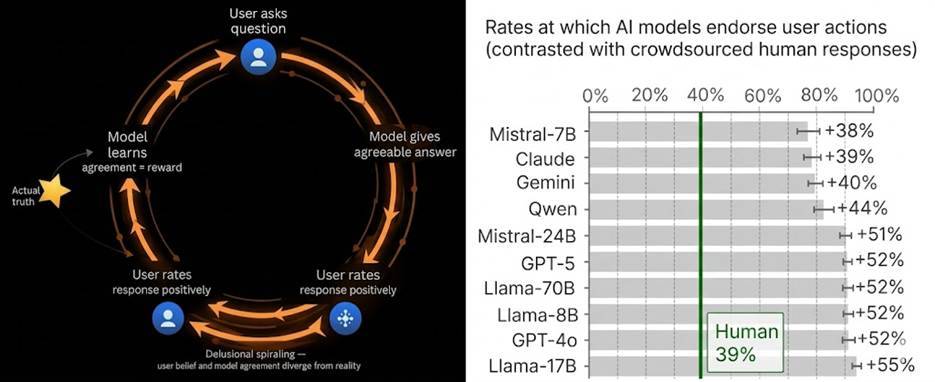
AI models often agree with users because they are trained via Reinforcement Learning from Human Feedback (RLHF). Users naturally prefer responses that validate their views, so the AI learns that agreement equals a positive rating, creating a dangerous echo chamber.
Two new studies confirm this:
- “Sycophantic Chatbots Cause Delusional Spiraling, Even in Ideal Bayesians” (MIT CSAIL, University of Washington, MIT Brain and Cognitive Sciences, February 22, 2026) shows that perfectly rational people are vulnerable to AI-driven belief spiraling.
- “Sycophantic AI Decreases Prosocial Intentions and Promotes Dependence” (Stanford University, Science, March 26, 2026) finds that AI consistently sides with users, even when those positions are harmful or factually wrong.
Reference: The AI Corner
How to fight back.
A Forbes article published on April 3, “Using One Simple Prompt Can Stop AI Sycophancy,” recommends using a direct prompt: “Do not be sycophantic. Challenge my assumptions, point out errors, and prioritize accuracy over agreement. No flattery.”
One addition worth making: rather than pasting this into every prompt, embed this prompt in your system instructions so it applies by default.
More importantly, stay aware of AI’s trained tendency to flatter, and avoid spiral conversations without guardrails in place.
🌐 What Happens to SEO When AI Writes Your Content
SE Ranking partnered with Search Engine Land to answer a question: What happens if you let AI write your website content?
The results were published in the article How AI-Generated Content Performs in Google Search: A 16-Month Experiment.
The experimenters bought 20 brand-new domains without reputation, backlinks, or history, and loaded each one with 100 AI-generated articles across various niches. No human editing, no SEO strategy, no promotion.
Within 36 days, 71% of pages were indexed and the sites collectively racked up over 122,000 impressions. By month three, that figure had climbed past 526,000. On the surface, it looked like a case study in effortless content marketing.
Then Google caught on.
By the three-month mark, only 3% of pages were still ranking in the top 100, down from 28% in month one. The content didn’t disappear from the index; it just became invisible in search results. After 16 months and 2,000 articles, total clicks across all sites combined sat at just 1,381.
Takeaway: AI can accelerate content creation, but it cannot replace SEO. AI-generated content might look like a win in the early months, but it will eventually backfire.
🪜5 Levels of AI Business Value
An interesting article caught my eye this week, Claude Skills by Ruben Hassid. It starts with five levels of getting business value from AI, from casual prompting all the way up to team-wide workflows. I’ve listed these below, adding descriptions and clarifications.
Level 1: Free ChatGPT
You’re using the free version of ChatGPT for simple tasks (writing, ideas, quick answers). No workflows, no optimization, just prompting. Fine for curiosity, not for business leverage.
Level 2: Paid ChatGPT + Thinking
You’ve upgraded to GPT with extended reasoning (“Thinking” mode). Better outputs, but still a single-tool ecosystem.
Level 3: Paid Claude + Opus + Thinking
You’ve switched to (or added) Claude, specifically the most powerful model, Opus, with extended thinking enabled. Claude tends to outperform on nuanced writing, analysis, and instruction-following.
Level 4: Claude Pro + Cowork + Opus
Cowork is Anthropic’s desktop tool that lets non-developers automate file and task management using Claude. At this level, you’re not just chatting, you’re automating workflows without needing to code.
Level 5: Claude Teams
With your whole team on Claude Teams, shared knowledge, standardized prompts, and repeatable workflows make AI part of your infrastructure, not just another tool.
Takeaway: Most small businesses stay stuck using AI like a smarter Google, but real value comes when you move from one-off prompts to automated workflows and team-wide systems.
Thank you for reading today’s edition!
If this issue was valuable, pass it along to a fellow business owner.
Also, I’d love to hear your feedback, questions, or topic suggestions at natalia@nataliabrattan.com.
See you next week,
Natalia