
👋 Welcome back to AI for SME Success, your weekly dose of practical AI insights for small businesses.
Today we cover:
- OpenAI updates for small business owners
- Why ChatGPT flyers can cost you sales, and what to do instead
- Google Social Tracking, Meta’s Muse Image, and Claude’s Dashboard
- 4 AI use cases for business growth
Let’s dive in! 👇
🤖 GPT-5.6 for Business Operations
OpenAI shipped three updates at once along with instructions for business operations.
On July 9 OpenAI moved GPT-5.6 from limited preview to general availability. It arrived alongside two products that matter more to small businesses than the model itself.
- GPT-5.6, three model tiers. Sol (flagship), Terra (balanced), and Luna (budget). API pricing runs from $1 to $5 per million input tokens, with Luna at roughly one-fifth of Sol’s cost.
- ChatGPT Work. A desktop agent that browses the web, edits files, connects to Slack, Google Drive, and Salesforce, and builds slides, spreadsheets, and documents. It directly competes with Anthropic’s Claude Cowork.
- GPT-Live. A voice mode you can talk with and interrupt naturally, closer to a phone call than a voice assistant like Alexa.
ChatGPT users: OpenAI just launched a new Business Operations collection on ChatGPT Learn with prompts and step-by-step instructions for using ChatGPT Work to turn “project trackers, KPI dashboards, planning documents, meeting notes, and stakeholder context” into “reviewable briefs, decisions, models, and updates”.
Non-ChatGPT users: GPT-5.6 is marketed as a very close competitor to Fable 5 at lower cost. However, Fable 5 still leads on broad intelligence, knowledge work, tool use, and coding. According to one hands-on reviewer, Claude Fable 5 wins where nuance matters including “long-running projects, strategic judgment, complex codebases, editorial taste, and understanding the intention underneath a request.”
😬 ChatGPT Flyer Hall of Shame
The world is flooded with ChatGPT images, and they are so easy to spot!
The brushstroke boxes are the dead giveaway, but even without them, the waxy lighting, the over-tidy composition, the generic stock-photo faces, the bright text on dark backgrounds, and the stray arrows and checkmarks tell the story.
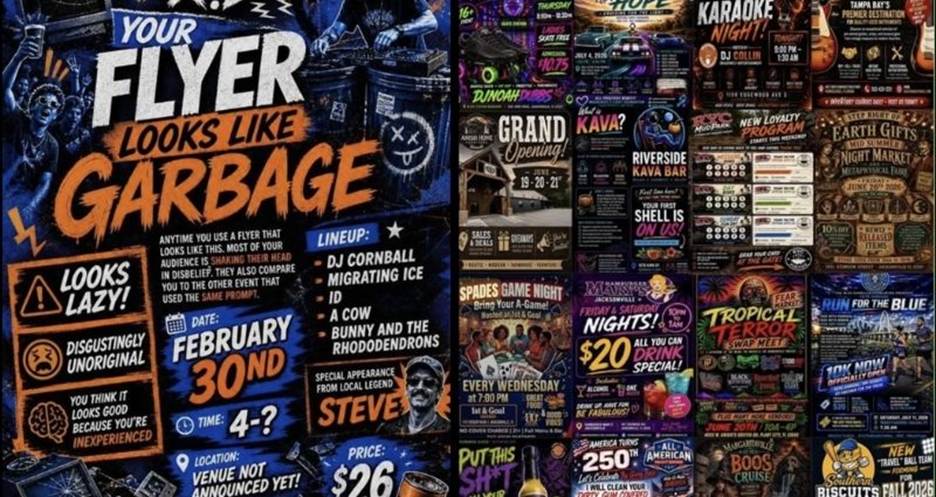
Sources: Jill Oliver and 404 Media’s “ChatGPT flyer pandemic”
They look 100% AI, and they are off-brand!
404 Media’s Jason Koebler spent early July cataloguing what designers now call the “ChatGPT flyer pandemic” (July 8, 2026): near-identical AI posters selling everything from surf lessons to fundraisers. Readers sent in so many examples that 404 ran a hall of shame follow-up five days later.
These AI flyers are cheap to make but can cost you sales. A June 2026 Harris Poll, 4As and Infillion survey found that 78% of consumers say AI makes ads feel less authentic, and 63% are less likely to buy from brands leaning on it.
There are AI tools that do a much better job. One is Google Pomelli, built specifically for on-brand visuals. It scans your website and extracts your business DNA (colours, fonts, imagery, and tone), then turns it into fully editable, on-brand visuals. It can even turn phone photos of your products into studio-quality shots.
Takeaway: don’t use plain ChatGPT for your marketing materials. Use a tool that knows your brand.
📲 Google Social Tracking, Meta’s Muse Image, and Claude’s Dashboard
If your business lives on social instead of a website, you can now see how you show up in Google Search.
- Search Console updates. You can now track how your Instagram, TikTok, X, and YouTube posts perform in Google Search and Discover, no website required. Add your account as a property in Search Console to see which queries surface your posts. Rolling out gradually over the coming weeks (announced July 7), so it may not appear in your account yet.
Meta
- Muse Image. Meta released a free AI image generator available in the Meta AI app, Instagram Stories, and WhatsApp. It generates and edits images from plain-language prompts, for ad creation and product visuals. It ranks second on the Arena text-to-image leaderboard.
- Muse Spark 1.1. Muse Spark 1.1. Meta’s first paid AI model, built for agents, coding, and computer use. The API is priced at roughly a quarter of what OpenAI and Anthropic charge, per CNBC. On the consumer side, Meta One also undercuts rivals (Plus at CA$7.99 and Premium at CA$21.99), but it’s a social-app enhancement layer, not a standalone productivity product.
Anthropic
- Reflection dashboard for Claude: A beta feature (July 9) that analyzes up to 12 months of your conversations and shows recurring topics, task types, and where you lean on AI most. You can set quiet hours and break reminders. Incognito and health-related chats are excluded.
- Fable 5 gets a cost fix: To stay competitive, Anthropic also reset all usage limits and says a new setup where Fable 5 delegates to the cheaper Sonnet 5 delivers 92% of its coding benchmark performance at 63% of the cost.
🧀 4 AI Use Cases That Grew 13 Accounts to 300
Fortune’s article “Meet the California cheese mogul who turned to AI agents to save his iconic $50 million business” features a small creamery that successfully adopted AI for business operations.
Petaluma Creamery, a 113-year-old California dairy, was running on paper and memory. Salespeople used a 150-SKU code hierarchy to take orders. CTO Daniel Peter’s first move was not AI: he ran fiber internet to the plant, moved 20-plus years of emails, QuickBooks invoices, and lab data to the cloud, then layered AI on top. These changes helped to grew active account from 13 to over 300.
Here are four AI use cases implemented by the company:
- Plain-language orders. The new interface lets sales reps find products through natural language search rather than memorized SKU hierarchies. No memorized codes, no mental math, minimal training for new staff.
- Predictive reorders. The system learns each customer’s buying cycle and pre-populates the order for a rep to confirm. It also flags items customers usually buys but did not mention, recovering revenue lost when a shelf label goes missing.
- Delivery optimization. Delivery routes and constraints are now written in natural language. Updating the algorithm means editing a sentence.
- Product traceability: milk supply characteristics (volume, temperature, time, source farm) are logged at farm arrival and tracked through production cycle. The company can now trace back the cheese to the load of milk for compliance.
Thank you for reading today’s edition.
If this issue was valuable, pass it along to a fellow business owner. I’d love to hear your feedback at natalia@nataliabrattan.com.
See you next week!