
👋 Welcome back to AI for SME Success, your weekly dose of practical AI insights for small businesses.
Today we cover:
- ChatGPT for small business vs. rivals
- Google’s AI tool stack for launching a side hustle
- Small business vs. enterprise AI spending
- Latest AI tool updates: Anthropic, Microsoft, and OpenAI
Let’s dive in! 👇
🏪 ChatGPT for Small Business vs. Rivals
On July 21, 2026 OpenAI launched ChatGPT for small business program, which combines new AI capabilities with training and implementation support.
The centerpiece is ChatGPT Work, an AI agent that can complete longer, multi-step tasks.
The program also includes free virtual training, in-person academies across the United States, and resources for business owners.
How does it compare with key rivals? How to choose?
- ChatGPT for Small Business. Best if you sell things: ecommerce, marketing, content at scale, product imagery and video. It includes partner tools and special offers from Dropbox, Shopify, Intuit, Slack, Atlassian, and Wix.
- Claude for Small Business, launched on May 13. Choose for documents and back-office: contracts, proposals, policy, bookkeeping close, anything where being wrong is expensive and the output is long-form prose. Weakest at native image and video. It offers integrations through partner connectors for platforms like QuickBooks, PayPal, and HubSpot.
- Gemini. Your top pick if your team runs on Google Workspace. It’s built right into your existing subscription, making it the default budget pick, and excels at social visuals. On June 10, Google added small-business features, including direct connection with Google Business Profile and Business notebooks for local SEO, brand management, and review tracking.
- Microsoft 365 Business with Copilot. Made for deep spreadsheet work, long email threads, and SharePoint document sprawl. Worth it if your team lives in Office all day. Launched July 1, it adds connectors across apps like Shopify, PayPal, Xero, Docusign, and Asana to automate functional tasks and workflows for small businesses.
Takeaway: In just over two months, all four leading AI providers launched programs and features for small business. They are different, and as an owner you can choose based on what matters most for your business.
🚀 Building Side Hustle with Google Gemini
Google mapped its AI stack to the five jobs of starting a side hustle in a new article 5 ways to build a side hustle with Gemini.
Here is the playbook:
| Ideation | Dump ideas into a Gemini notebook, then add links, files, and reference materials. |
| Market research | Google Deep Research browses hundreds of sources and returns a competitor or market report in minutes. |
| Branding | Build a full brand kit with Pomelli from Google Labs. |
| Operations | Gemini Spark, a personalised AI agent runs standing instructions in the background, like logging new client emails to a sheet. |
| Pricing | Use Gemini to upload costs and fees, find break-even, and model tiers against projected revenue. |
💸 AI Spending: Small Businesses vs. Enterprises
Some interesting numbers came out of Ramp, a US platform for corporate card and bill payments.
Here are the insights:
- Small firms spend more per headcount: Small US businesses spend a median of $20.06 per employee each month on AI, more than 7 times what large firms spend ($2.86). Medium firms sit in between at $8.33. Large firms still pay more in absolute dollars, spread across bigger headcounts.
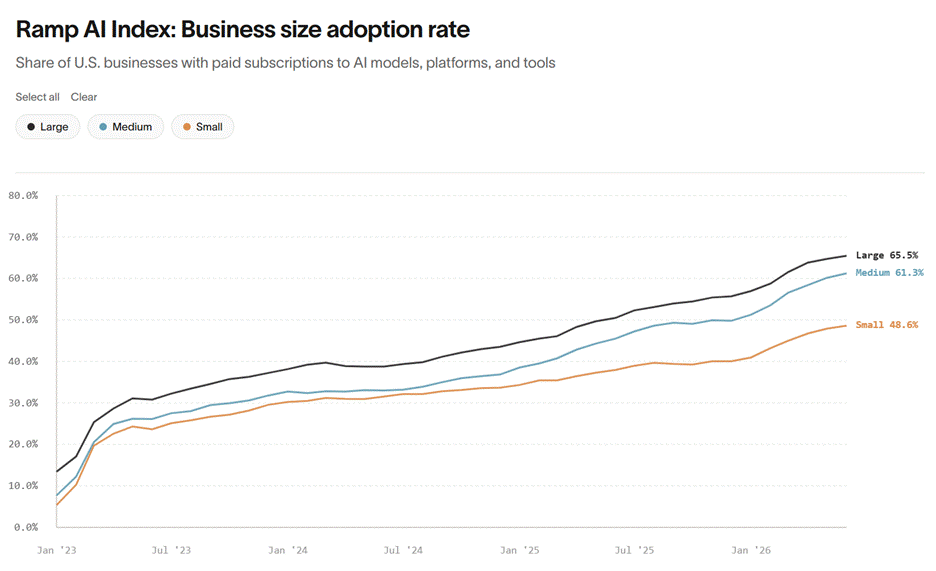
- Paid adoption keeps climbing: 66% of large companies, 61% of medium, and 47% of small businesses now hold paid AI subscriptions and tools.
Source: Ramp AI Index
- Two providers own the market: Anthropic leads at 42.4% of businesses and OpenAI at 39.5%, with Google, xAI, and DeepSeek splitting the rest.
- Anthropic dominates API spend: roughly 88% at small firms and 90% at medium and large ones. API (application programming interface) dollars mostly go to coding and agentic work.
Takeaway: AI is more expensive to absorb for small businesses. Per Business Insider, small businesses that rely on AI already budget for price fluctuations. Anthropic and OpenAI dominate the market, with Anthropic leading on the API side.
🛠️ Latest AI Updates: Anthropic, Microsoft & OpenAI
Major AI labs shipped last week. Here is what matters for a small business:
OpenAI
Ads Manager. OpenAI opened its self-serve Ads Manager to businesses. You can sign up directly, set budgets and bids, and run campaigns in ChatGPT, with cost-per-click bidding and no minimum spend. OpenAI says it is built for businesses of all sizes, but it’s best viewed as an early-stage marketing channel rather than a replacement for Google Ads or Meta Ads.
Anthropic
Claude Opus 5. Near the intelligence of Anthropic’s top public model, Fable 5, at half the cost. Strong on coding, long tasks, and document analysis.
Microsoft
MAI-Image-2.5-Pro & MAI-Voice-2-Flash. A sharper image model that renders readable text inside images (signs, posters). This means cleaner product shots, better social graphics, and faster slide creation. MAI-Voice-2-Flash adds capability to read text in a natural voice, fast enough for real-time conversations.
Thank you for reading today’s edition.
If this issue was valuable, pass it along to a fellow business owner. I’d love to hear your feedback at natalia@nataliabrattan.com.
See you next week!