
AI-related misinformation and disinformation rank among the top five global risks identified in the World Economic Forum’s 2025 Global Risks Report.
A survey of 1,532 randomly selected Canadians conducted by the Harris Poll Canada in Oct 2025 revealed that nearly 90% of Canadians are concerned about AI-generated misinformation. While the survey is news-related, it clearly illustrates general users concerns about AI-generated work.
Your clients have every reason to be concerned about AI-generated content. They can be concerned not only the risk of undetected errors, AI hallucinations or misinformation, but also potential bias and the safety of their personal information.
Your client can also have concerns about compound AI errors. For example, situations where one AI-generated output feeds into another system or model, amplifying small mistakes into bigger ones.
As a business owner, you need to address these concerns before they arise.
Key Takeaways
✅Customers are more cautious than ever about AI.
In an era defined by misinformation, disinformation, and ongoing data breaches, customers need clear assurance that the AI use in businesses is safe and trustworthy.
✅Beginner Business Response. Evaluate Risks and Disclose.
Create a documented AI Policy that defines where and how AI is used in your business. Identify and mitigate potential risks such as data privacy, bias, or misinformation. Be transparent with customers about AI use in your products or services.
✅Intermediate Business Response. Align with NIST AI RMF.
The NIST AI Risk Management Framework (AI RMF 1.0) and its Playbook provide practical guidance for identifying, assessing, and mitigating AI-related risks. Following NIST principles helps your organization better manage AI risks in alignment with industry best practices.
✅Advanced Business Response. Adopt ISO 42001.
For organizations that heavily rely on AI in higher-risk or regulated environments, aligning with ISO 42001, the AI Management System (AIMS) standard, demonstrates a strong commitment to safe, ethical, and transparent AI use.
Let’s dive in!
Growing Concerns About AI Use
In today’s environment of misinformation, disinformation, and data breaches, customers are very cautious about AI use. Whenever AI supports your customer communication or operations, think about how it affects their trust.

The Rise of Misinformation and Disinformation
A study by Statistics Canada found that 43 % of Canadians said it was becoming harder to distinguish true from false information, a trend that affects business-to-consumer trust.
In Canada, businesses face mounting threats from AI-enabled misinformation and disinformation. A white paper titled “Understanding and Responding to Disinformation Targeting Canadian Companies” identifies how false or manipulated content created via generative AI is being used to undermine brands, sink share prices, and damage reputations.
For example, attackers might generate fake executive videos, bogus product-failure announcements, or deepfake imagery that appears convincingly real. The advisory by the Canadian Anti-Fraud Centre warns about AI-driven voice- and text-based scams impersonating senior figures to defraud companies.
For SMEs, the implications are clear: even a small false narrative amplified by AI can erode customer trust, trigger a crisis, or create legal exposure.
Information Security and Privacy Concerns
An Enterprise AI & SaaS Data Security Report (2025) from LayerX Security exposes alarming trends that affect organizations of every size, including small businesses.
The report reveals that 45% of employees now use AI tools daily, and 77% admit to copying and pasting business data into those tools.
Even more concerning, 62% of employees paste sensitive data, and 40% of files uploaded to AI platforms contain confidential information such as client details, internal documents, or financial data.
For small businesses, these findings are a wake-up call. Imagine your employees using ChatGPT to draft emails. They might be unknowingly sharing private customer information through personal accounts.
Or consider your team collaborating through Slack or WhatsApp, where 87% of workplace messaging happens outside company oversight, creating blind spots for data leaks.
Even traditional cybersecurity measures, like password policies, are no longer enough. Between 71% and 83% of business app logins bypass proper authentication or corporate security controls.
AI adoption is happening faster than most businesses can secure it, and customers are worried.
How to Manage AI Risks and Transparency with NIST
If your business uses AI in low- or medium-risk applications, you can maintain stakeholder trust through transparency and responsible risk management. The NIST AI Risk Management Framework (AI RMF 1.0) and Playbook provide practical guidance for identifying, managing, and disclosing AI-related risks.

How to Manage AI Risks
Let’s take for example a small marketing agency that uses a generative AI system to produce client content. The agency first documents the AI system’s intended purpose, data sources, and stakeholders. It identifies key risks such as “confabulation” (false or misleading outputs) and “intellectual property violations.”
Next, the firm assesses how often the AI generates inaccurate or plagiarized content by tracking “confabulation rates” and verifying output originality using plagiarism-detection tools. NIST recommends quantitative assessments aligned with organizational risk tolerance.
Then the company creates response policies, such as manual human review for all client-facing material and retraining of the model when accuracy metrics drop below set thresholds. These actions address residual risks.
Finally, the SME establishes clear accountability by designating one employee to oversee AI compliance, content provenance, and client communication in case of detected bias or misinformation.
These actions of the marketing agency are aligned with the NIST AI Risk Management Framework which includes four functions: map, measure, manage, and govern AI related risks.
How to Lead with Transparency
While NIST does not mandate AI disclosure, it strongly encourages voluntary transparency to build trust and accountability.
The AI Risk Management Framework (RMF) Playbook advises organizations to communicate clearly about AI use and related incidents. Likewise, the NIST AI 600-1 Generative AI Profile highlights disclosure, content provenance, and incident reporting as essential elements of responsible AI governance.
For a small marketing agency, this means adopting several best practices for AI disclosure.
Clients should be informed early, ideally in proposals or contracts, when AI tools assist in creating copy, imagery, or analysis.
Disclosures can be written in clear language, such as: “Some elements of this campaign were developed with AI tools and reviewed by our creative team for accuracy, originality, and alignment with brand values.”
Businesses can also add visible content labels or watermarks on AI-generated visuals, maintain records of AI-assisted work for accountability, and include an AI use statement on their websites.
When errors or biases occur, prompt incident disclosure and corrective communication further demonstrate ethical responsibility.
How to Strengthen Credibility with ISO 42001
If your business relies heavily on AI, particularly in medium- or high-risk applications, demonstrating alignment with ISO 42001 AI Management System can significantly strengthen trust and confidence among your customers, business partners, and other stakeholders.
What is ISO?
The International Organization for Standardization (ISO) is an independent, non-governmental body that develops globally recognized standards to ensure quality, safety, and efficiency across industries.
Headquartered in Geneva, ISO unites national standards bodies from over 160 countries to create a common global language of best practices.
ISO standards cover a vide variety of topics from product specifications to cybersecurity and management systems. Many of ISO standards are adopted by national standardization organizations worldwide.
ISO’s management system standards rank among the most recognized globally.
What is a Management System?
According to ISO, “a management system is the way in which an organization manages the interrelated parts of its business in order to achieve its objectives. These objectives can relate to a number of different topics, including product or service quality, operational efficiency, environmental performance, health and safety in the workplace and many more.”
There are two types of ISO management system standards.
Core management system standards establish requirements that any organization can apply, regardless of size or industry.
Examples include:
- ISO 9001 – Quality management systems
- ISO 14001 – Environmental management systems
- ISO 27001 – Information security management systems
- ISO 42001 – Artificial intelligence management systems
Sector-specific management systems address sector-specific risks and performance expectations.
Examples include:
- ISO 13485 – Quality management for medical devices
- ISO 22163 – Quality management for the railway industry
It All Started with ISO 9001
The story of international management systems began with ISO 9001, first published in 1987. It introduced a structured approach to quality management, emphasizing customer focus, leadership, evidence-based decision-making, and continuous improvement.
Today, ISO 9001 is the most widely implemented management system standard in the world, with more than one million certified organizations across 170 countries.
ISO 9001 become a universal framework for reliable, quality-focused operations in every industry.
How ISO 9001 Helps Small Businesses
Management systems can be adopted by organizations of any size, even solopreneurs.
Over the last thirty-eight years, many small businesses have achieved measurable success by implementing ISO 9001 quality management systems.
By declaring that they operate under a certified or recognized management framework, small businesses send a strong signal of commitment to quality to clients, investors, and partners alike.
As the company ISO Specialist explains, the benefits of using ISO 9001 for solopreneurs include:
“Setting up a management system properly not only makes certification easier, but also demonstrates that you are giving serious thought to quality assurance within your organization.”
What is ISO 42001 and How It Fits Small Business
ISO 42001 is the newest addition to the ISO family of management system standards, released in 2024.
Similar to ISO 9001, ISO 42001 applies to organizations of all types and sizes, across every industry sector.
It is equally relevant to large corporations and small and medium-sized enterprises (SMEs). In fact, ISO 9001’s adoption among small businesses was so widespread that ISO published a dedicated guide, ISO 9001:2015 for Small Enterprises – What to do?
ISO 42001 structure aligns closely with other ISO management system standards, supporting consistency and ease of integration.
According to ISO, ISO 42001 is “designed to cover the various aspects of artificial intelligence and the different applications an organization may be running. It provides an integrated approach to managing AI projects, from risk assessment to effective treatment of these risks.”
By aligning with ISO 42001, companies, including SMEs and solopreneurs, can reassure clients, investors, and partners that their use of AI is transparent, compliant, and trustworthy.
ISO 42001 for Small Business
For small business owners and solopreneurs interested in adopting ISO 42001, the first step is to obtain an official copy of the standard ISO 42001:2023 directly from the ISO website and review it.
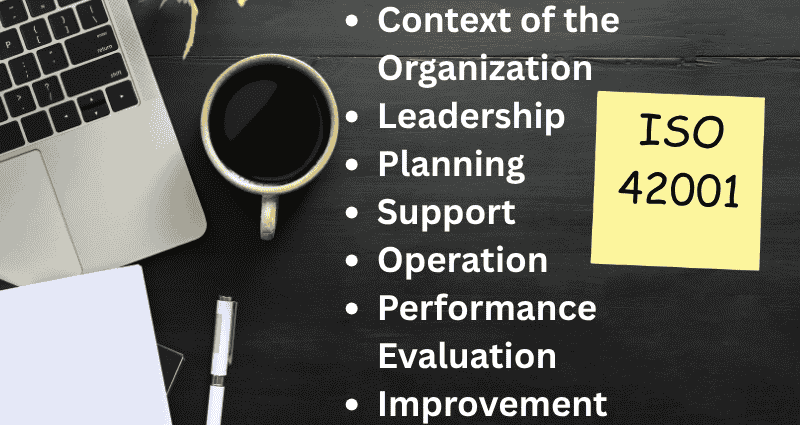
Guidelines of the document are organized in seven sections. Below is a brief overview of each section and recommendations for adoption by small business.
Context of the Organization
Summary. Organizations should understand the external and internal factors, such as laws, ethics, competition, and technology, that can affect their AI objectives. They must also identify stakeholders such as customers, regulators, employees, and the public, and determine their needs and expectations. Defining the scope of the AI management system (AIMS) ensures clarity on which AI systems and processes are covered. Finally, the AIMS itself should be established, documented, and continuously improved.
SME Actions. Conduct a simple SWOT analysis to identify key risks; list top stakeholders and their concerns (e.g., transparency, bias, privacy); define a manageable scope focusing on core AI activities; and maintain a digital record of AI policies and risk logs.
Leadership
Summary. Leadership must demonstrate commitment by allocating resources and setting clear direction for responsible AI use. This includes developing a concise AI policy aligned with business objectives and ensuring clear roles, responsibilities, and authorities for managing AI compliance.
SME Actions. Write a one-page AI policy and have the business owner endorse it. Assign roles using a simple RACI chart.
Planning
Summary. Organizations must identify and address AI-related risks and opportunities proactively. They should set measurable objectives for AI performance and governance. Any changes to AI systems or processes must be planned to avoid new risks.
SME Actions. Keep a lightweight risk register updated after major AI changes, establish SMART goals (e.g., improve model accuracy or reduce bias), and record planned modifications in a change log.
Support
Summary. Adequate resources, staff competence, awareness, communication, and documentation are crucial to AIMS success. Employees and contractors must be trained on AI use, aware of their responsibilities, and supported by information and tools.
SME Actions. Allocate modest budgets or time for AI governance, provide essential AI training, include AIMS awareness in onboarding, appoint an AI communications contact, and store all documents in a shared, version-controlled folder.
Operation
Summary. AI-related activities should be planned and controlled to meet requirements safely and effectively. Regular risk assessments, implementation of risk treatments, and evaluation of AI system impacts are required.
SME Actions. Use checklists before AI deployment, perform regular risk assessments and mitigations, and periodically evaluate impacts using templates.
Performance Evaluation
Summary. Organizations should monitor, measure, analyze, and evaluate AI performance. Regular internal audits and management reviews should be conducted to verify that the AIMS remains effective and aligned with organizational goals.
SME Actions. Track key metrics like model drift or incident reports, appoint an reviewer for internal audits, and hold annual management review meetings to evaluate performance and define improvements.
Improvement
Summary. Organizations must continually enhance the effectiveness of their AI management system. When nonconformities occur, corrective actions should be taken to eliminate causes and prevent recurrence.
SME Actions. Maintain an issue log to track problems and corrective measures, and document lessons learned to refine future AI projects.
In a nutshell, this is how a small business can put the principles of ISO 42001 into practice. Your organization can either self-declare compliance or pursue formal certification, which includes periodic external audits.