Welcome back to AI for SME Success, your weekly dose of quick, actionable AI insights for your small business.
Here’s what we’re covering today:
- NEW GPT Image 1.5 vs. Nano Banana Pro
- Is It Safe to Use AI Browsers?
- AI: The New Human Right?
🖼️ NEW GPT Image 1.5 vs. Google Nano Banana Pro
Last night, OpenAI released a major upgrade to its image generation tool: GPT Image 1.5. This update appears to be a clear “code red” response to the rapid adoption of Gemini’s image tool, Nano Banana Pro.
The upgrade introduces a dedicated image tab, runs up to 4× faster, and now allows users to add, subtract, and blend visual elements.
This morning, we tested both tools across five small business use cases.
Overall conclusion
GPT Image 1.5 is a significant improvement over previous version of Open AI. The biggest gains are in infographics and whiteboarding, where it now matches and, in some cases, exceeds Nano Banana Pro. That said, GPT Image 1.5 still struggles with preserving original image dimensions and with designing additions to existing illustrations.
Let’s dive in 👇
1️⃣Design Change
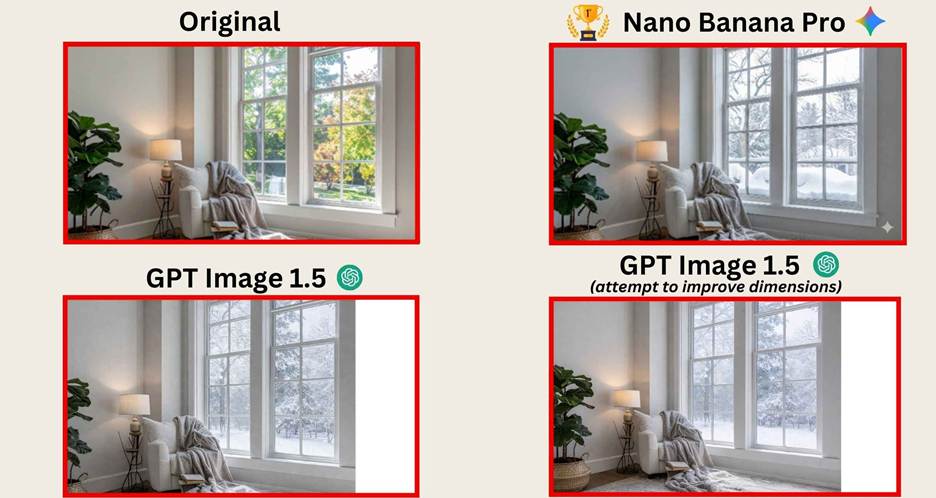
Prompt: Change the outdoor view in my Zoom background from summer to a snowy winter.
Just like its predecessor (v5.0), GPT Image 1.5 failed to preserve the original image dimensions, even after re-prompting. Nano Banana Pro handled it better.
🏆 Winner: Nano Banana Pro
2️⃣ Adding Visual Elements
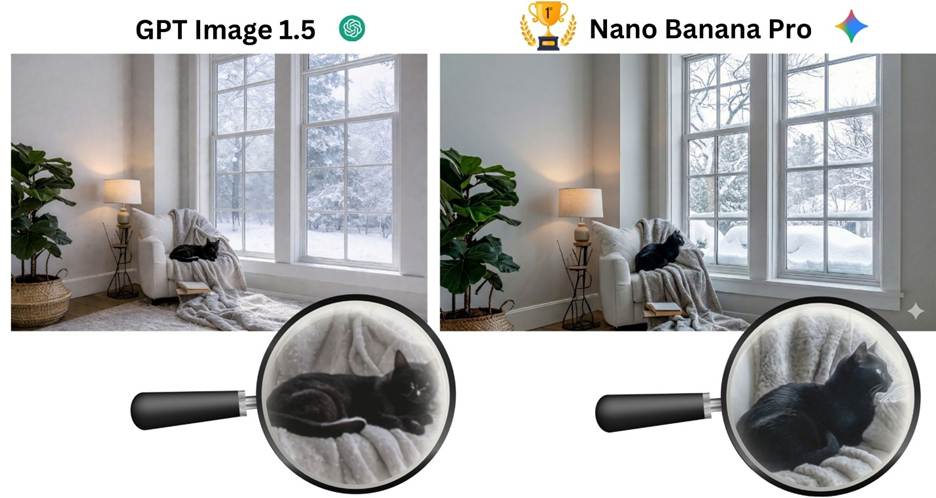
Prompt: Add a black cat sitting on the chair in the image.
GPT Image 1.5 added a cat-like shape, but it lacked facial details. Nano Banana Pro’s result was better.
🏆 Winner: Nano Banana Pro
3️⃣Infographics
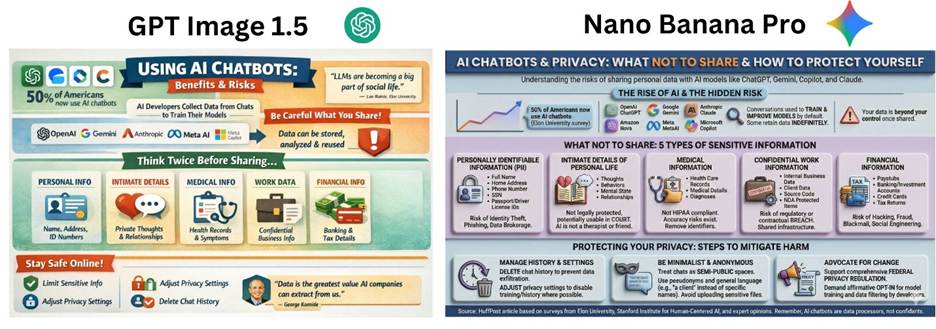
Prompt: Turn this text into an infographic.
Both tools were not great at using information from a link, so we copied and pasted the content of the article “The Information You Should Never Share With ChatGPT“ into the tools.
Both tools produced accurate, visually appealing infographics. Notably, when we tested the same article on the previous version of ChatGPT, it missed 2 out of 5 key “do not share” categories. This marks a huge improvement.
🏆 Winner: Tie
4️⃣Whiteboarding
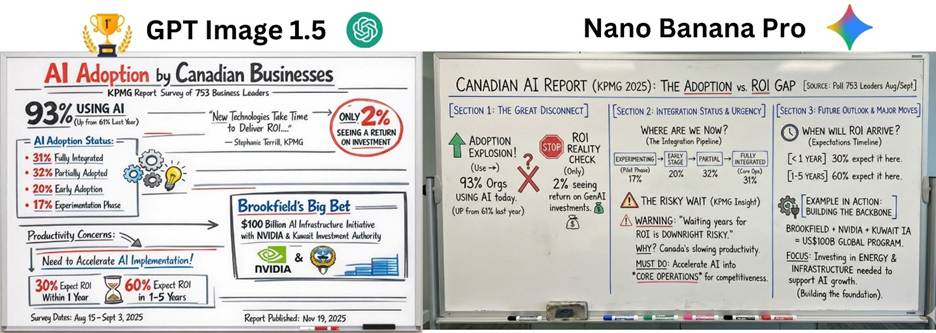
Prompt: Summarize the text on a whiteboard.
I pasted the content of the article AI adoption by businesses up, but few seeing returns so far: KPMG report into both tools and prompted them to summarise the content on a whiteboard.
GPT Image 1.5 pleasantly surprised me. I loved how key statistics were clearly presented using color, spacing, and structure.
🏆 Winner: GPT Image 1.5
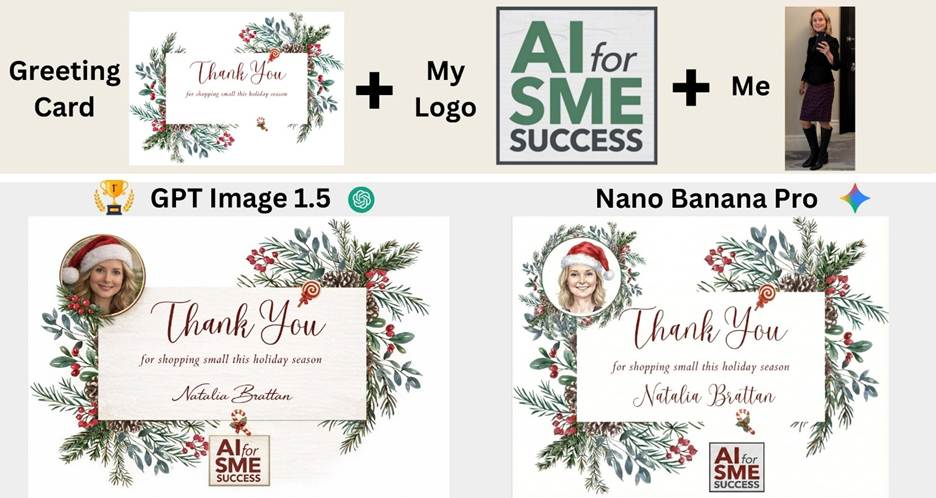
5️⃣Merging Multiple Images
Prompt: Modify the greeting card by adding my portrait as a circular frame (face only) wearing a Christmas hat in the top-left corner. Place my logo at the bottom of the card under the candy cane, recolored to match the card’s palette. Add my signature ‘Natalia Brattan’ to the text box below the writing area.
I uploaded a greeting card from Canva, my photo and my logo to both tools.
GPT Image 1.5 produced a more polished, professional design and even matched the text box background to my logo. However, it again failed to maintain the original image dimensions and over-retouched my face.
🏆 Winner: GPT Image 1.5
🔒Is It Safe to Use AI Browsers?
At the beginning of December, Gartner published an advisory report Cybersecurity Must Block AI Browsers for Now.
The report warns that “Sensitive user data, such as active web content, browsing history, and open tabs, is often sent to the cloud-based AI back end.”
AI browsers create security risks far greater than standard ad tracking.
While Chrome or Safari track where you visit to serve ads (metadata), these new “agentic” browsers often ingest the actual content of your screen to function.
For example, if you have a confidential document open in a tab, the AI browser may upload that full text to a third-party server to “read” the context.
Gartner concludes that until these tools improve data governance, the risk of accidental information leakage is too high.
⚖️AI: The New Human Right?
Wait, what?
Masayoshi Son, CEO of SoftBank Group Corp., is now calling AI access “almost like a human right,” just like electricity and motorization.
In a recent TIME interview, he warned that countries or communities without access to superintelligence and super-robotics won’t just be behind, they will be ‘dramatically left out.'”
It’s a bold claim: future inequality won’t just be about resources, but about access to AI.
Is your business ready?
Source: TIME: SoftBank CEO: Access to AI Will Become a Human Right
Talk soon,
Natalia