👋 Welcome back to AI for SME Success, your weekly dose of quick, actionable AI insights for small businesses.
Here’s what we’re covering today:
- Two New Studies on AI’s Limits
- Gemini Introduces Personal Intelligence
- Google Agentic Commerce for Retailers
- ChatGPT Go & Sponsored Results
- Thoughts on Big Changes from Davos
Two New Studies on AI’s Limits
Two interesting studies came out this week.
A The Decoder article, “Even the Best AI Models Fail at Visual Tasks Toddlers Handle Easily,” published on January 18, explains that even the most advanced multimodal AI models struggle with basic visual tasks that toddlers handle with ease. In benchmark tests, leading models scored far below human baselines on very simple tasks, such as identifying the correct piece in a basic puzzle.
Similarly, a Popular Science article, “Why Does AI Suck at Making Clocks?”, published on January 10, examined how humans and computers read time. The conclusion was: humans read analogue clocks with 89.1% accuracy, while the best-performing AI achieves only 39.4%.
As one study cited in the article explains: “Our findings suggest that successful temporal reasoning requires a combination of precise visual perception, numerical computation, and structured logical inference that current MLLMs have not yet mastered.”
In other words, today’s AI models can’t reliably see, do arithmetic and reason at the same time.
Want to test AI’s visual limits yourself? Ask any model to draw 20 to 50 objects with their names, like articles of clothing, vegetables, or animals.
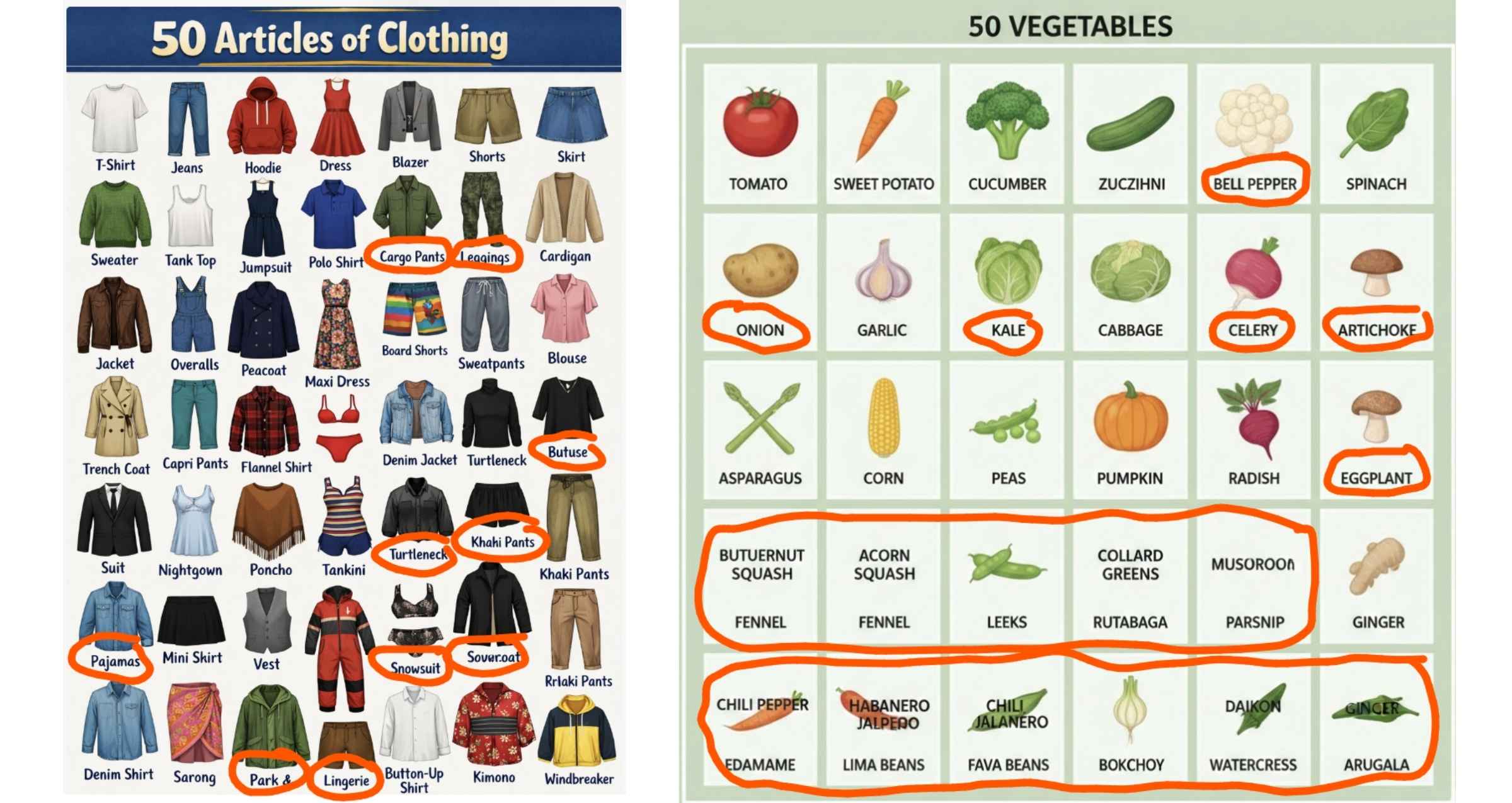
Illustration: AI-generated errors highlighted in red
The result will include duplications, mismatched labels, and messy layouts.
Takeaway: Always give AI tasks it’s capable of doing, not tasks you wish it could do. Learn AI’s limitations before you draft your prompts. When it comes to illustrations, keep your Ai generated visuals simple.
Gemini Introduces Personal Intelligence
Until now, you had to explicitly tell Gemini where to look, for example, “Search my email for the invoice.”
With the new Personal Intelligence feature introduced on Jan 14 in beta for Google AI Pro or AI Ultra subscribers, Gemini uses your connected apps as background context for every prompt. It can understand your upcoming trips, recent project themes, and preferences without you having to point it to a specific file each time.
Personal Intelligence creates a more fluid “memory” of your interactions. It learns from your past searches, files, emails, pictures, and YouTube history to better understand your working style and business niche.
Without Personal Intelligence enabled, you might ask for a summary of an email thread. With the new feature, you can ask, “What should I prioritize today?” and Gemini will check your Calendar for meetings, your Gmail for urgent requests, and your Photos for a receipt you snapped yesterday.
According to Google, your data remains secure and is not used to train AI models.
Takeaway: If you decide to enable Gemini Personal Intelligence, make sure to clean your data, separate personal and business accounts, and review Workspace permission controls first.
Google Agentic Commerce for Retailers
On Jan 16 Google introduced the Universal Commerce Protocol (UCP), “a new open standard designed to let AI agents, apps, businesses, and payment providers interact seamlessly without needing custom, one-off integrations for every connection.”
With UPC, SMEs can deploy branded Business Agents that act as virtual salesclerks, answering product questions and offering real-time pricing directly in search results.
Customers can now discover, chat, and purchase without leaving the Google interface. By adopting this open-source standard, your business can offer “one-click” AI shopping while remaining the Seller of Record.
Takeaway: If you sell across your website, Google Search & Shopping, ads, AI agents and partners, new Google UCP is worth paying attention to, but requires clean data, upfront setup, and tolerance for early-stage errors.
ChatGPT Go & Sponsored Results
OpenAI officially launched the ChatGPT Go tier worldwide on January 16, 2026. The new plan sits between the Free version and Plus ($20 USD), offering a more affordable upgrade path.
In Canada, ChatGPT Go costs approximately $11–12 CAD (billed as $8 USD) and provides 10× more usage than the free tier, along with a longer memory window.
In the same January 16 announcement, OpenAI also revealed plans to begin testing “Sponsored Recommendations” for Free and Go-tier adult users in the U.S. in the coming weeks, marking a notable shift toward ad-supported experiences.
Google Gemini currently remains ad-free.
Takeaway: ChatGPT stands out for its unique strengths compared to many alternatives. The new ChatGPT Go plan is a solid, reasonably priced option, but keep an eye on the potential introduction of ads down the line.
Thoughts on Big Changes from Davos
The world is changing at the speed of light, and AI is a major force driving this global shift.

Source: World Economic Forum (January 20, 2026).
This week in Davos, global leaders are gathering for the World Economic Forum. I bookmarked a few quotes from Canadian Prime Minister Mark Carney’s speech that, in my view, capture a thoughtful way to navigate big change:
- “If we’re not at the table, we’re on the menu.”
- “The question for middle powers like Canada is not whether to adapt to the new reality – we must. The question is whether we adapt by simply building higher walls, or whether we can do something more ambitious.”
- “We know the old order is not coming back. We shouldn’t mourn it. Nostalgia is not a strategy, but we believe that from the fracture we can build something bigger, better, stronger, more just.”
Takeaway: For small business owners, this is a powerful way to think about massive shifts, including AI:
- Don’t just adapt, approach change with ambition.
- Nostalgia is not a strategy.
- If you’re not at the table, you’re on the menu.
Till next week,