
👋 Welcome back to AI for SME Success, your weekly dose of practical AI insights for small businesses.
Today we cover:
- Worried about AI agent security? Start with these low-risk tasks
- What the top 10% of AI adopters do differently
- SME Spotlight: AI wins in October
Let’s dive in! 👇
🚦 Worried About AI Agent Security? Start With These Low-Risk Tasks
You have good reasons to question AI agents. Still, there are plenty of low-risk ways to put them to work.
AI agents’ popularity is skyrocketing. Meta’s personal AI agent, Muse, reached 10.2 million U.S. downloads in its first 40 days, nearly three times ChatGPT’s pace.
So are concerns about their accuracy and security. Last month, researchers at Claroc found thousands of shared Muse chats that outsiders could find and open without signing in, some with confidential information. Meta has since paused the sharing feature.
A September survey of people who build, buy or influence AI systems found that more than half of respondents said an agent had done something wrong in the past 90 days, from triggering workflows that had to be reversed to responding inappropriately to customers.
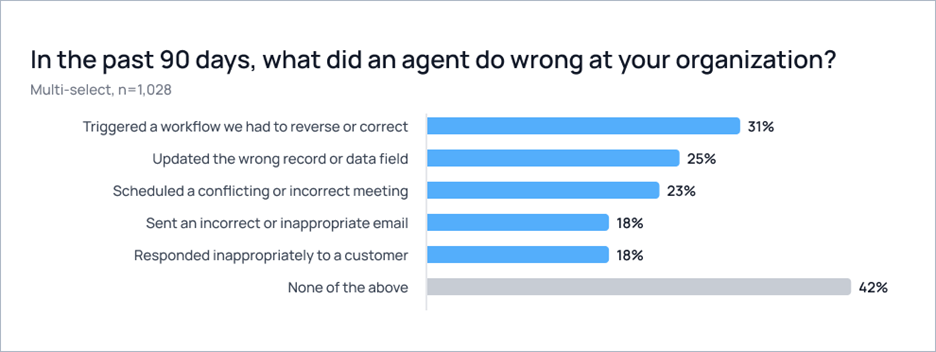
Source: Nylas. The State of Agentic AI, H2 2026: What the agents did wrong
While AI agents are still uncharted territory, we can already use them for what a chatbot can’t do: work on their own, across many websites, week after week.
Where is it safe to use AI agents? For example, an agent can watch municipal tender sites for new requests for proposals that match your services, check conference pages for open calls for presentations, and flag grants or funding programs as they open. It can work through dozens of websites, podcast directories and event listings to build a shortlist of leads, collaborators and networking events, with the reason each one fits. It can also track changes you would otherwise miss, such as a competitor’s new prices or a fresh review of your business.
These tasks are low risk because the agent only reads public pages and reports back to you. Check every detail on the official source before you act.
🏆 What the Top 10% of AI Adopters Do Differently
Google’s latest survey found that while 91% of organizations have an “AI-first” goal, only 10% have reached the report’s “mature” stage.
Here’s what they do differently:
- They redesign workflows. When AI takes over routine steps, people’s roles shift to designing the process and validating the output. For example, AI drafts quotes and proposals from your site notes, and people review and send them.
- They put AI where work happens. Top adopters build AI into the tools their teams already use. For a small business, that means the AI included in the email, calendar and file tools you pay for, under that provider’s security. Instead of pasting client details into a chatbot, ask it to summarize the thread before a call.
- They know what it costs. 72% of organizations say AI goals are outgrowing their budgets, but top adopters are more likely to understand AI costs well enough to plan long term. Start by listing every AI subscription, who uses it and how, and fund only use cases with proven ROI.
- They clarify AI boundaries. 80% of respondents say AI makes human judgment more important, yet only 35% of employees say there are clear rules for what AI may do alone. A one-page AI policy can close that gap.
🔦 SME Spotlight: AI Wins in October
Many small business owners chat with AI, but very few turn those chats into business wins. Here are two recent case studies with ideas you can replicate.
From forklift driver to tech founder with AI
Mike Nickason, 52, spent 20 years driving forklifts. While off work, he started vibe coding (telling AI in plain language what to build) on $20-a-month Claude, Codex and ChatGPT plans.
The result is KW Live, a dashboard that maps emergency updates, transit alerts and traffic cameras across his region. It has drawn about US$70,000 in grants and support, including from Google for Startups, CTV reports.
Takeaway: Vibe coding is within reach of people with no technical background. Many AI-coded apps have security flaws, so start with one that uses only public data your customers care about, and get a security review before it touches any sensitive data.
They wouldn’t be in Forbes without AI
VJ Roworth and Adrian Beadell run Leonard’s Lookout, a four-bedroom cave-house rental in Spain, on a ChatGPT plan that costs about 20 euros a month. When Roworth asked AI how to attract more guests, ChatGPT suggested press coverage, then found a Forbes writer, drafted the pitch and prepared her talking points, leading to this article.
Takeaway: Use AI as your publicist: ask it to find writers who cover businesses like yours and draft a pitch, then check the facts and contact details and send it yourself. The worst case is that nobody replies, and the best is free press.
Thank you for reading today’s edition.
If this issue was valuable, pass it along to a fellow business owner. I’d love to hear your feedback at natalia@nataliabrattan.com.
See you next week!