
👋 Welcome back to AI for SME Success, your weekly dose of practical AI insights for small businesses.
Today we cover:
- Meta’s AI for Small Businesses
- How to Steal Like a Creator (with Meta.AI)
- Why Audit Your AI System Instructions
- This Week In AI: Tool Updates
Let’s dive in! 👇
💼 Meta’s AI for Small Businesses
Meta’s small-business AI features come with data no other AI can match.
Over the last few months almost every major AI provider launched programs and features for small businesses, including ChatGPT, Claude, Gemini, and Microsoft.
On August 19, Meta AI “joined the club” and launched small business features, and it is still free!
Meta.AI has a unique edge, which is its access to Facebook, Instagram, and WhatsApp data no other AI tool can reach. Now you can ask Meta AI to audit your account, pull a list of followers with specific characteristics, benchmark your content, search events, and so much more. Meta AI can also analyze the performance of your Facebook and Instagram posts, including reach, saves, shares, comments, and profile visits.
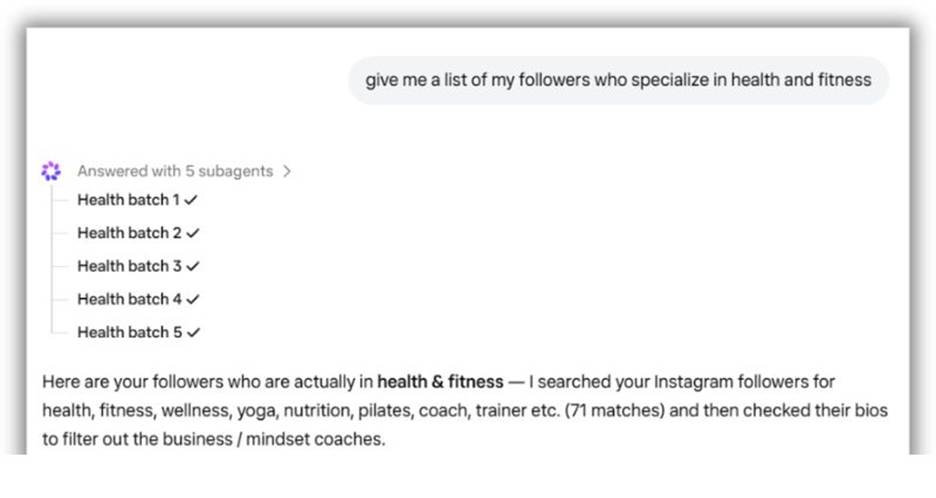
Non-Instagram and Facebook users can ask Meta.AI to research similar businesses on Facebook and Instagram, analyze their public content and engagement, and identify opportunities to differentiate your brand.
Meta.AI can also create presentations, documents, and spreadsheets using information from your business and the web.
Questions you can ask Meta AI:
- Which IG reels on [your topic] posted in [your timeframe] have over one million views?
- What types of my Instagram content worked best over the last XX days?
- Compare my Instagram performance with 5 top and leading brands in my industry.
- Analyze my advertising results from the past 90 days. What’s performing well, what isn’t, and what should I adjust over the next month?
🛍️ How to Steal Like a Creator (with Meta.AI)
Competitor analysis is one of the highest-leverage growth opportunities. Here’s how to do it.
The very first strategy that famous creator Ali Abdaal recommends for success in 2026 is competitor analysis, which he calls “unreasonably effective.” Behind every big creator we know is a team constantly watching, analyzing, and learning from what other creators are doing, both within their niche and related to it.
They are not trying to copy what someone else is doing. Instead, they are looking for ideas and inspirations to put their own twist on them.
In Ali’s example, his team found an outlier, a video by creator Nisha called “17 Tiny Habits That Made Me Rich.” That inspired Ali to create his own version, “1-Minute Habits That Made Me More Productive.”
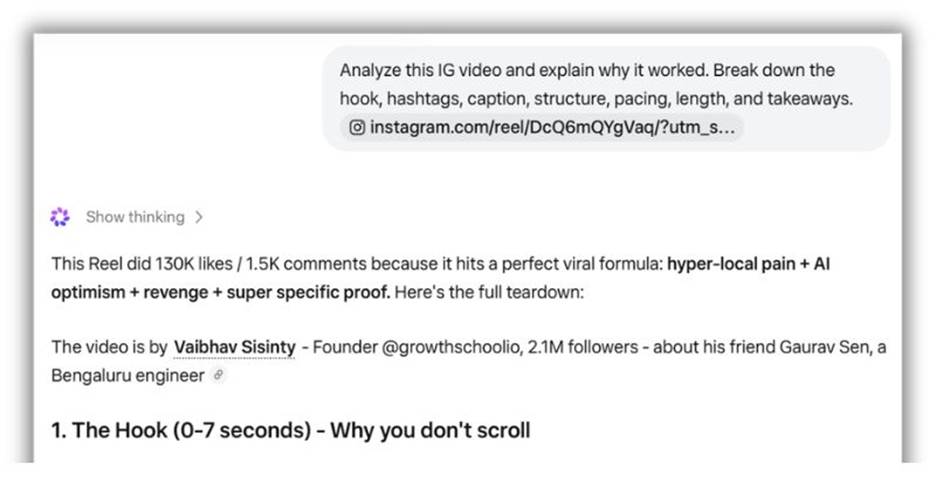
Here is how you can do it with Meta AI:
- Find a high-performing Instagram or Facebook post in your niche.
- Analyze it with this prompt: “Analyze this IG video and explain why it worked. Break down the hook, hashtags, caption, structure, pacing, length, and takeaways. [Link to the video]”
- Then build your own version: “Create a hook, hashtags, caption, structure, pacing, length, and takeaways for my post on the topic [your topic]. Optimize it for [your platform].”
If you are not active on Instagram or Facebook, you can use the insights for your marketing and product materials.
🧹 Why You Should Audit Your AI System Instructions
AI capabilities are improving rapidly. So should your AI skills and system instructions.
At Y Combinator’s Startup School 2026, Claude Code creator Boris Cherny noted that users should audit and update their AI system prompts, skills, and system instructions at least twice a year.
AI providers’ guides on AI prompting are updated regularly. As a best practice, AI users should keep pace. In most cases, that means simplification. Boris’s team cut more than 80% of Claude Code’s system prompt for the new model.
Updating AI skills and system instructions improves the model’s responsiveness, effectiveness, and accuracy.
This does not apply to security rules, compliance policies, and command blockers. Those should not be simplified. Do not strip guardrails just because the model got smarter.
Takeaway: If you keep saved instructions in tools like ChatGPT, Claude Projects, Gemini Gems, or a custom GPT, revisit them regularly. Ask the model which instructions are no longer needed or can be simplified.
📡 This Week In AI: Tool Updates That Matter to SMEs
Anthropic:
- Anthropic launched Claude Academy, a free learning hub with hundreds of tutorials and prompting guides.
- Anthropic now embeds an invisible, machine-readable watermark in text Claude generates, to meet EU transparency rules. It won’t show to readers, but detection tools can flag AI involvement.
Google:
- You can now personalize the content you see across Google Search, Discover, and News, save Preferred Sources, and customize your audio briefings.
- Gemini Notebooks can now be copied, so you can build one notebook (onboarding docs, a research base, a client brief) and duplicate it as a reusable template instead of starting over.
- Gemini’s visible AI watermark is now optional on images, video, and music. Invisible marks stay embedded, so AI origin is still traceable.
OpenAI:
- OpenAI released an Apple Messages plugin for ChatGPT’s desktop app. If you run customer or supplier conversations through iMessage, you can search threads, check updates, and send replies from the same window where you already draft with AI.
Thank you for reading today’s edition.
If this issue was valuable, pass it along to a fellow business owner. I’d love to hear your feedback at natalia@nataliabrattan.com.
See you next week!